
Why Body Mechanics Matter More Than Lifting Weights
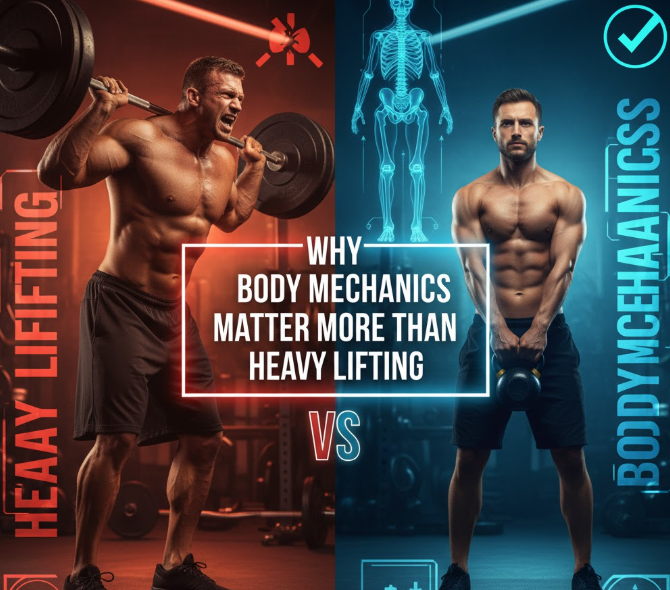
Walk into any gym, and a familiar courtship dance is underway: one of the players is lifting heavy things that no average person could ever move — grunting agonizingly with each effort! — in order to look good on the beach come summer. In another corner someone is cruising through exercises like it’s a piece of cake; the perfect control, with moderate weights and ease in his/her effort. Fast forward six months, and guess who is pain-free at training, while the other has a lower back injury?
Lifting the most possible weight someone can is a quality that has been championed for years in our fitness world. Social media feeds are filled with videos of individuals lifting monster weights, garnering hundreds of likes and comments. But here’s what those viral moments don’t reveal: the months of physical therapy that often accompany them, the chronic pain that accumulates over time and the altered movement patterns that persist for years.
Body mechanics — the manner in which your body moves through space and can handle forces — trumps heavy lifting, every time. Your movement — the way you hold your body and how freaking well/poor that is, more than anything else determines a level of health or injury. This isn’t, in other words, purely fitness philosophy; two separate lines of decades-old research in biomechanics and physical therapy and sports science undergird it.
The True Cost of Poor Movement Patterns
Your body has been sculpted into a highly advanced machine, perfectly capable of moving as intended. Every joint and every muscle has a natural range of motion and function, and then you have your nervous system that coordinates all of this on the fly. When you ignore these basic principles, and choose weight over form, you are programming your body to use bad software.
Deficient body mechanics lead to compensatory ways of moving. Your body is intelligent—it will always manage to perform a movement involving itself, it also does not mean that that way was correct. Deadlift with a slumped back even once, and your body may never forgive you. Do it a thousand times and you’ve trained your nervous system to normalize this dangerous pattern. When you teach your body to move improperly, the weight doesn’t matter.
Think about the classic situation where someone is lifting heavy weight in a deadlift with a rounded spine. They could get the bar up, but what they’ve done is taught their spinal erectors to work inappropriately, trained their glutes not to fire properly, and then cued them into movement when it should be done elsewhere—like by stronger posterior chain muscles. The weight went back up, of course, but at what price? Memories of years of potential training ruined by a disc herniation, sciatica or chronic back pain.
Your Body’s Innate Configuration and Order of Motion
Human bodies have been evolving for millions of years to move in coordinated patterns. These patterns consist of, in descending order of frequency: the squat, hinge, push, pull, rotate and carry. There are biomechanical benchmarks for each of these movements that contribute to the maximum amount of force production with minimal possibility for injury.
The hip hinge, for instance, is meant to be initiated from the hip joint and not the lumbar spine. Your hips are built to deal with coma-inducing loads — they’re supported by some of your body’s most powerful muscles, including your glutes and hamstrings. Your lower back, on the other hand, is built for stability — not mobility. When you hinge from your back instead of the hips, it’s like asking a stabilizer to act as a mover.
Joint positioning matters tremendously. Your shoulder joint, a ball-and-socket-style joint that offers amazing range of movement and less stability than other joints. When you press weight overhead with internally rotated shoulders and flared elbows, you’re simply compressing soft tissues in your shoulder capsule — and exponentially increasing the risk of injury in doing so. A few extra pounds are never worth a torn rotator cuff that could render you bench-bound for half a year.
The Neuromuscular Link: Getting Your Nerve On
It isn’t just about getting bigger muscles, but training your nervous system to use those muscle fibers effectively and coordinating complex movement patterns. Your brain and muscles communicate along neural pathways, and these pathways grow stronger with repetition — for better or worse.
When you practice movements with correct body mechanics you are developing strong, efficient neural pathways. Your brain figures out how to turn on your muscles in the optimal sequence, at the optimum time. This is motor learning, and it’s the basis of all skillful movement. An athlete that can perfectly squat under their own bodyweight is now worth more from a motor pattern perspective than the person who squats much more weight poorly.
Motor learning is achieved through repetitions and feedback. Each time you move, your nervous system receives feedback about the position of your joints, the tension in your muscles, how balanced you are and how forcefully you’re producing a movement. With good mechanics, this becomes a reinforcing loop for solid movement patterns. If you have bad mechanics, in a sense you practice mistakes a thousand times and those wrong patterns become automatic.
Injury Prevention: The ‘Long Game’ No One Really Knows or Talks About
The fitness world, as a rule, commemorates short-term victories: how much more you deadlifted that month, how many pounds you lost that quarter, how rapidly you achieved X physique. Lost between the cracks is the type of person who’s trained regularly and consistently for 20 years with no major injuries, is still spry in their sixties, never had surgery due to issue preventable through strength training.
Good body mechanics are a form of injury prevention. Even if you’ve lost that perfect neutral spine and are not “using it”, if you maintain one during loaded movements, then the forces get transmitted across many structures rather than getting focused in high risk zones. By maintaining knee tracking over the toes during the squat, you protect your knees from unwanted shear forces on the ligaments. You’re also preventing disc injuries in your spine here by keeping a tight core with rotation movements!
The math of getting hurt is a damning reality check. Research has found that lifting with poor form can increase your risk of injury around 200-400% depending on the exercise. That means you’re three to five times as likely to get hurt by increasing weight at the expense of form. The equation is simple: perfect form with moderate weight equals forward progress; heavy weight with bad form equals physical therapists.
Creating TRUE Strength from the Ground Up
Here’s a fact that surprises a lot of people: You can gain plenty of strength and muscle with moderate weights and good form. Does it really all come back to time under tension, quality of movement, and progressive overload in good form?
When you squat perfectly — knees out, chest up, neutral spine, full depth — you recruit all the necessary muscle groups in the most optimal fashion. Your quads, glutes, hamstrings and core work in efficient harmony. This provides a better training effect than simply going heavier for partial ROM or using momentum.
Strength coaches who have a good grasp of biomechanics program movement quality first, load second. They would have an athlete eating weeks of bodyweight training before adding any external load. Not because their coach isn’t ambitious, but because he or she knows that motor patterns in young athletes are formed early and shape long-term athletic development.
The Functional Fitness Reality Check
Real-world strength isn’t how much you can lift in a controlled gym setting with the best equipment and ideal conditions possible. It’s gauged by how your body responded to the unpredictable demands of daily life: lifting awkward objects, playing sports, avoiding falls, responding to sudden movements.
How to use your body properly = How well you can move it. Once you train your body to hinge properly, bending over to pick up a heavy box is second nature and safe. Once you’ve mastered stability in your shoulders, reaching overhead to grab something from a high shelf or stacking shelves with heavy items doesn’t feel like a way of courting injury. When you’ve got good core stability, throwing out your back is not a thing anymore when you move suddenly or twist around.
Athletes learn this principle quickly. The squat is a highly beneficial exercise that even many football players will not achieve an optimal level of load during their career (over 600 pounds), because beyond a certain point, the athlete becomes less efficient at changing direction. Ultimately, the weight room numbers mean little compared to movement quality on game day.
Common Movement Errors and Their Implications
| Exercise | Fault | Corrective Movement | Incorrect Form Injury |
|---|---|---|---|
| Deadlift | Rounded lower back | Neutral spine, Hip hinge | Herniated disc, Chronic back pain |
| Squat | Knee cave | Knee tracking over toes | ACL, meniscus |
| Overhead Press | Excessive lower back arch | Neutral spine, Stable core | Lower back strain, Shoulder impingement |
| Running | Over striding, Heel strike | Midfoot, 170-180 Cadence | Shin splints, Knee, Open fracture |
| Bent Over Row | Rounded thoracic | Flat back, Proper hip hinge | Upper back strain, Shoulder Issue |
The PROPER Method of Applying the Progressive Overload Principle
Stepwise increment of training stimuli, also known as progressive overload—progressive increase in stress on the structure and function of the body—is regarded as the fundamental pillar of strength gains. However, most individuals view this to mean “slap more weight on the bar.” Real progressive overload does so in accordance with biomechanical principles that raise the stimulus of training.
You can make progress by cleaning up the movement, increasing range of motion, adding reps, shortening rest time or changing tempos before you even touch a heavy load. A person who can perform the pistol (single-leg) squat perfectly and beautifully, has progressed themselves a lot over someone who can simply do squats with weight.
For example, if you were working on push-ups and your training experience does allow it, you might use the following progression: standard push-up → pause bottom push-up → slow eccentric (lowering) push-up → decline push-up → weighted push-up → more advanced variations. The first two progressions get slightly harder by challenging your stability, yet the mechanics remain correct. This method develops strength that’s durable and carries over to other movements.

Age, Experience, and Movement Quality
The young body frequently gets away with bad mechanics due to sheer resilience and ability to heal itself. If you are 20 years old, you can lift some God-awful way for years before it comes back to get you. This has the dangerous illusion that mechanics are irrelevant. Then they turn 30 and every training session is accompanied by a new ache or pain.
Quality of movement becomes more and more important as we age. Research suggests the health of joints and structural connective tissues declines slowly. The person who spent their twenties using perfect form through their sequences continues to train injury-free in their fifties and beyond. The individual who pursued the most weight encounters increasing physical constraints and pervasive injury.
Fitness should make you appreciate good form more, not less. Experienced lifters realize that the art of their training career is all about smart programming and good form. They had seen too many people flame out over preventable injuries to repeat the same mistakes.
Creating a Movement-First Training Approach
A program that is built on quality of movement as opposed to maximum loads will require a shift psychologically. So instead of “How much can I lift?” ask “How well can I move?” This shift in frame alters everything about how you train.
Begin each workout with a movement prep. Then, 10 minutes practicing the bodyweight version of your movements you’ll be loading throughout today and concentrating on perfect form. This is not merely a warm-up; it’s rehearsal of the motor patterns that your nervous system will require in order to do them properly under load.
Use video analysis regularly. Good form may feel perfect — but often isn’t. It provides objective feedback that your body’s sensory system might not get from just one angle. When you see yourself squat, you may find that tracking issue with your knees, a problem with the position of your spine, or discover that you’re not squatting quite as deep as you think.
Prioritize bilateral and unilateral balance. Lots of folks develop imbalances that weaken mechanics. If you’re right side-dominant while your left is weak (or vice versa), your body is likely taking on the other’s slack during the warping of an exercise it believes to be symmetrical (such as squats) — causing an asymmetrical loading pattern and increasing injury risk. When you workout on one leg; or with a 1 arm exercise are when these imbalances can be exposed and fixed.
The Importance of Being Mobile and Flexible
If your limbs don’t have the ability to move adequately, you cannot have good body mechanics. And so then you down all that stuff, and your hip flexor muscles get tight as fuck, limiting a full extension in the hips while deadlifting. Squats, and your heels rise very high due to inflexible ankles! A limited thoracic spine drives some compensatory action in your lumbar spine.
Mobility work isn’t a nice-to-have; it’s a need-to-have. Time spent on specific flexibility and mobility exercises will develop the physical ability to execute correct movement patterns. This is not to say you should be forever doing slow, long static stretches before workouts, which can decrease force production temporarily. Instead, rely on dynamic mobility drills and focused tissue work to deliver joint maintenance.
Now think of the overhead squat, a lift that requires a lot of mobility in ankles, hips, thoracic spine and shoulders. The majority of the population does not have a squat good enough to do this at first, not necessarily because they are weak but because they don’t have the mobility for it. By breaking these restrictions down through structured mobility work, good form tends to just fall into place.
Mind-Muscle Connection and Movement Awareness
The exercise of good body mechanics is the concentrated, conscious awareness of how your body occupies space. This is something that can be learned, trained and improved upon: your proprioception, or sense of your own body’s position in space. Athletes who naturally have a better sense of proprioception will always have good form because they can feel when their body is not in the proper position for optimal mechanics.
To cultivate movement awareness is to slow down and pay attention. Instead of flying through reps, go in slow motion, noticing each muscle activating, every joint articulating. This deliberate type of training helps develop the neural connections controlling movement quality.
How you breathe matters, especially when it comes to body mechanics and stability of the core. It’s a loaded movement that does wonders for your posture and overall strength through proper breathing, as you’ll be creating intra-abdominal pressure that protects your spine. Learning to breathe and brace properly — breathing in to tighten your core, holding the breath with the most challenging part of a lift and then exhaling it out — helps protect your spine (ever heard a coach say “breathe into your belt” during a heavy squat?) but can also increase force production.
Quality of Movement vs Load Over Time
| Time Frame | Heavy Load, Poor Form | Moderate Load, Perfect Form |
|---|---|---|
| Week 1 | Lifts heavy weights, feels proud | Focuses on technique, feels easy |
| Month 3 | Starts developing niggles | Making steady progress but no aches |
| Year 1 | First major injury, takes 6 weeks off | Continues training but shows strength gains |
| Year 3 | Has chronic issues, backs off exercise intensities | Grows linearly in intensity and stays pain-free |
| Year 10 | Has multiple injuries and limited forms of training | Still makes some degree of progress with excellent movement quality |
Teaching Others: The Responsibility Factor
If you are a coach, trainer or train with others, you have an ethical duty to prioritize movement quality. We are teaching someone to add weight, before mastering the form and mechanics, setting them up for injury. The immediate ego boost of moving more weight isn’t worth the longer-term downside.
Even if you didn’t get it, good coaching puts the movement pattern first, every time. A good trainer will make an exercise regressive when form breaks down, even if that means taking off weight an athlete has succeeded with in the past. This is a skill that develops strength in the long term, and it’s good for athletic longevity.
Parents and adults who work out in front of kids should demonstrate excellent form. Young people are watching how you engage with training, and they learn by observing. The concept that form trumps weight is a lesson in life far outside the gym.
Rehabilitation and Movement Retraining
And when injuries happen—and they do eventually happen to almost every single athlete—good rehab is about retraining movements. Physical therapists emphasize correcting body mechanics because they know the injury was a result of poor movement.
There is no reason to rush back after an injury, you need patience and humility. You need to relearn basic movement patterns with body weight or very minimal loads to begin. This can be frustrating for someone who used to lift a lot, but not doing this pretty much guarantees re-injury. The body needs time to re-calibrate signals and restore the quality of tissue.
Most chronic injuries are sustained, not because of structural damage to the body, but due to faulty movement patterns that never change. The mechanical factors which led to the original injury can be corrected favourably, more effectively than by any one method.
Frequently Asked Questions
Can I gain muscle without lifting heavy weights but doing it perfectly?
Absolutely. It is well documented in the literature that muscle hypertrophy can take place at a wide spectrum of loads, given an adequate VOLUME and INTENSITY are trained. ‘If the form feels good, then repeat.’ Some very interesting data is accumulating that lifting light weights with perfect techniques taken close (but not to) failure gives similar muscle gains as going heavy with poor technique. The only benefit to lifting lighter weights is that you can accrue more high quality training volume without getting injured.
How can I tell if my form is good?
Film yourself from various angles and compare your movement with the guidance of professional coaches or therapists. Maybe consult with a good coach on form? “Keep an eye on the pain signals — good mechanics should not put sharp pain or joint discomfort in shut down mode.” Movement should be effortless and directed, rather than forced or compensated.
Can I ever lift heavy things again?
Yes, after you’ve dialed in the movement patterns. Hard lifting retains the benefits of strength, bone density, level of hormones. The key is that you earn the ability to load movements by consistently practicing good mechanics first. Heavy weight should be earned, not a default.
How long does it take to correct bad movement patterns?
This will be based on how long you’ve conditioned the dysfunctional patterns and the individual make-up of your body. Plan on dedicating at least 4-8 weeks to movement correction and frequently drilling high-quality patterns with light loading. Certain habits don’t change overnight, and can take months to correct. Consistency matters more than timeline.
What if using perfect form feels weak?
It’s normal for correct form to feel weaker at the start because you’re employing muscles that had been in disuse before and breaking compensatory patterns. This is normal and temporary. As your nervous system adjusts and the correct muscle recruitment patterns kick in, you will be stronger using good mechanics than you ever were moving poorly.

Bringing It All Together
Here’s the iron truth about strength training: your body doesn’t give a damn what numbers are in your log if they got there by performing exercises that wreck YOUR long-term performance. The weight you lifted yesterday doesn’t matter nearly as much as your ability to pain-free train tomorrow, next month and ten years from now.
Body mechanics is more important than heavy lifting because it will set the course for your entire career in training. Learn the correct movement patterns, and you’ll set yourself up for limitless growth. Disregard mechanics in favour of big and heavier, and you’re building on sand and waiting for the inevitable collapse.
The strongest people aren’t always the ones who can currently lift the most weight. They’re the ones who are still training consistently, moving well, making progress 20 years from now. The seventy-year-olds who can move into a faster groove than most forty-year-olds. They are the players who refuse to go down with injury season after season.
Choose to be one of them. Respect how your body is set up, maintain movement integrity and trust that strength off a basis of great mechanics will build faster than loading inspired by ego. And every time you train without pain, move with confidence and do something because your poor-form-practicing peers can’t don’t be surprised if your future self grins from ear to ear when thanking you.
The weight room isn’t going anywhere. You’ll only have a beneficial training window of time with healthy joints and proper movement patterns so long as you guard it. If you prioritize movement quality, all else in your training will take care of itself. And that’s not just fitness advice; it’s a plan for lifelong strength, health and physical capability.