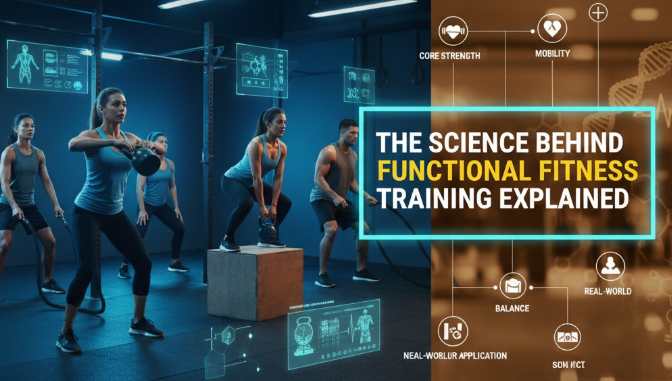

You may have heard trainers and fitness enthusiasts use the phrase “functional fitness” as if it is the holy grail of exercising. But what, exactly, sets this kind of training apart from traditional gym workouts? And most importantly, how is science supporting its status as one of the most effective ways to build real-world STRENGTH?
Functional fitness has nothing to do with how much you can bench press, or how many reps of bicep curls you can do. Instead, it emphasizes movements that have parallels with those of daily life — leaning over to pick up a bag of groceries, climbing stairs, bending down to play with your kids or standing from a chair. This training style has been blowing up the fitness world and for good reason, there’s actual science backing it up.
We’re going to break down the biology, physiology, and biomechanics that drive all of those CrossFit workouts. You will learn how your muscles, nervous system and joints interact during these exercises, and why this method might be precisely what your body wants.
What Makes Fitness “Functional”?
But before we go into the science behind it, let’s break down what exactly functional fitness is. In a classic gym workout, you often isolate muscle groups — say, your quadriceps with leg extensions or just your arms when you curl. Functional fitness pursues this from a different direction.
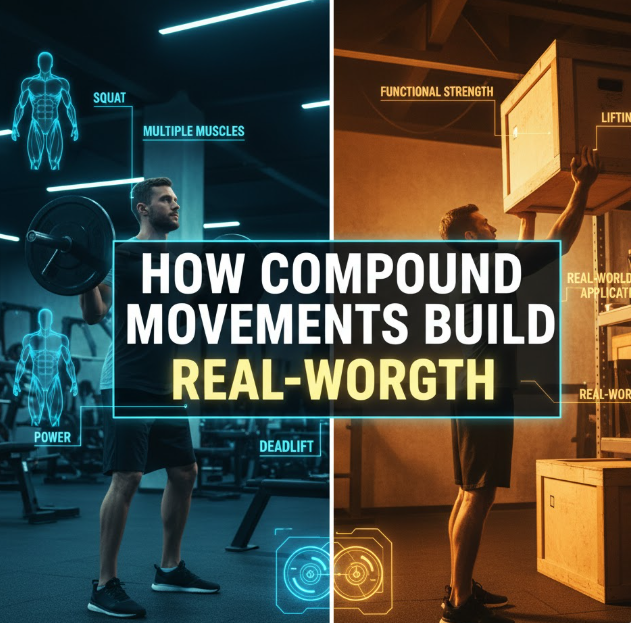
Functional exercises work multiple muscle groups at the same time and replicate the movements we make in everyday life. With each squat you do to retrieve a box, it’s not just your legs. Your core stabilizes your spine, your glutes drive the movement, back muscles keep posture and arms control the load. Functional training mimics these complex, multi-joint movements.
Typical functional exercises may include squats, lunges, deadlifts, push-ups, pulls and turn movements. These exercises have several things in common: They involve multiple joints, they demand balance and coordination, and they provide the greatest carryover to activities performed outside of a gym.
This Is Your Muscles on a Deadlift
In order to understand fitness science as it relates to functional exercises, we must first look at muscle physiology. Your muscles don’t work in isolation; they work with other muscle groups and adjacent joints and nerves to produce a movement, forming what’s called “kinetic chains.”
When you do a functional exercise like the squat, many things are occurring at once. Your quad muscles extend your knees, glutes and hamstrings control hip extension, core muscles brace your spine, as well as smaller stabilizer muscles throughout your body that keep you balanced. That leads to what physiologists term “intermuscular coordination” — the ability of different muscles to work together in an efficient fashion.
Studies published in sports science journals demonstrate that training patterns of movement as opposed to single muscles produces superior neural adaptations. Your brain learns action patterns, not simply how to flex certain muscles. This results in more efficient motor pathways, so your body can learn to better coordinate complex movements over time.
The Nervous System Connection
Here’s where functional training starts to become really fun. You’ve got strong muscles, but they’re only as good as the signals your nervous system conducts to them. Functional training increases what scientists refer to as “neuromuscular efficiency,” or how well your brain communicates with your muscles during exercise.
All of those hundreds of muscle fibers must be coordinated by your nervous system, figuring out which muscles to turn on and off and when, how forcefully to contract them and what order in which they should act. This requires sophisticated neural programming.
Old-school isolation exercises don’t really challenge this system. You’re sitting on a machine, doing leg extensions, serving as supports and all you have to do is push in one direction. Your nervous system doesn’t have to give it much thought.
Functional exercises force your nervous system to work harder. Because when you’re doing something like a single-leg deadlift, your nervous system is constantly making adjustments to keep you upright and balanced and coordinate antagonistic muscle groups to prevent you from falling over. This builds stronger neural pathways and enhances body awareness, known to neuroscientists as “proprioception.”
Movement Patterns That Matter Most
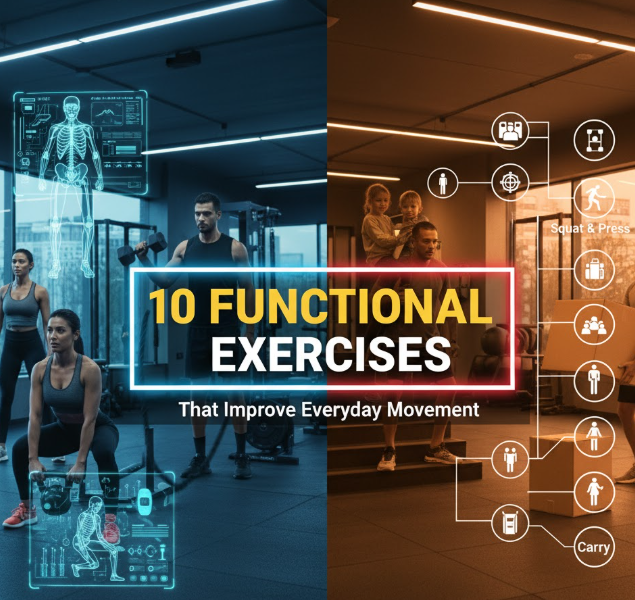
Physical therapists and exercise physiologists have recognized that there are a couple of basic movement patterns that humans are capable of making, which include squats or pushing yourself from the ground. In fact, these patterns are seen throughout everyday life and athletic pursuits.
The primary movement patterns include:
Squatting: Sitting in a chair and getting up, picking things up from the floor, entering or exiting an automobile. This movement is the bending of the hips and knees with a straight back.
Hinge Pattern: Bending over from the hip with a straight back. You do this every time you tie your shoe, pick something up, or even lift anything from the floor. The deadlift is the original hinge movement.
Push Pattern: The pattern of pushing objects away from your body. That would include holding a door open, hoisting grocery bags up onto the shelf, standing from the floor. Do horizontal pushes (as you would do in push-ups) as well as vertical pushes (à la overhead presses).
Pull Pattern: Bringing objects in towards you. Pulling open a heavy door, rowing a boat and climbing all employ pull patterns. Just as with pushing, pulling can take place in both the horizontal and vertical dimensions.
Pattern of Rotation: Rotate your trunk, not your hips. When you swing a golf club, throw a ball or simply reach behind you for something in the car, you rotate.
Step Type: Walk and run. It may sound elementary, but taking a correct step is a coordination whirlwind between your core, hips and legs.
That sort of training, which focuses on patterns rather than individual muscles, causes what researchers refer to as “functional transfer,” or transfer of the improvements you make in the gym into performance outside the gym.
Stability: The Core of It All
If there were a celebrity of functional fitness, it would be your core. But never mind what you think you know about abs. Your “core” is more than your six-pack muscles — it’s an entire system of muscles that stabilize your spine and transfer force between your upper body and lower body.
In addition to your abdominals and obliques, the muscles in your chest, upper back, lower back, pelvic floor, diaphragm — even your glutes count as part of your core. These muscles work together to generate what biomechanics specialists call “proximal stability for distal mobility” — or, in English, a stable core that permits your arms and legs to move explosively and safely.
By utilizing electromyography (EMG) — the system that records muscle activation — studies demonstrate how your core muscles fire off differently while performing functional moves when compared to traditional ab work. With exercises like planks or compound movements, your core muscles are constantly contracting isometrically, where the muscle creates tension without going through a range of motion. And this is exactly how they work in real life — stabilizing your spine as your extremities move.
According to the Journal of Strength and Conditioning Research, people with greater core stability are better at just about any physical task you can name — from gardening to walking on an icy road — and less likely to experience a fall-related injury as they get older.
Balance, Proprioception: Your Body’s G.P.S. Device
An often overlooked perk of functional fitness is balance and body awareness. Your body also comes with a natural navigation system: proprioception, or your body’s innate sense of where its parts are in space without having to look at them.
Proprioceptors are specialized nerve endings in your muscles, tendons and joints that send information to the brain on a continuous basis about position, movement and tension. Functional training, particularly exercises with unstable surfaces or one-legged balance are excellent for enhancing this system.
Researchers have also found that better proprioception can decrease the risk of injury. The moment you step on an uneven surface or begin to slide, your own proprioceptive system can direct muscle activations in milliseconds — quicker than your conscious brain can be bothered to respond.
Proprioception, similarly, isn’t challenged much in traditional machine-based workouts since the machine controls the path of movement. Functional exercises, especially those with balance challenges, are overloading your proprioceptive system and generating positive adaptations that increase coordination and reduce risk of injury.
The Metabolic Advantage
Functional fitness training is more than what meets the eye. It’s not just about building strength and coordination; you will also gain impressive metabolic benefits. Functional exercises involve the use of large muscle groups, and there is more energy expenditure produced by a functional exercise that uses multiple muscle groups simultaneously.
Studies comparing these types of full-body movements to isolation exercises have found that full-body functional movements burn more calories during your workout and also produce a larger “afterburn” effect afterward. This afterburn, referred to scientifically as excess post-exercise oxygen consumption (EPOC), means that your metabolism remains elevated for hours following exercise.
One study published in the Journal of Applied Physiology discovered that circuit-style functional training can increase metabolism for up to 38 hours post-workout. It occurs because your body has to repair various muscle groups as well as rebuild glycogen stores, and return the cellular environment back to normal — all of which requires energy!
Joint Health and Injury Prevention
The science which speaks most persuasively to functional fitness is its impact on the health of your joints. Traditional bodybuilding exercises reinforce muscle imbalances and place unneeded stress on the joints because they require you to stabilize the weight while doing the exercise, isolating the muscles.
This is how functional training works — it develops the muscles and connective tissues in an integrated manner, with stabilizers reinforced in conjunction. This results in balanced strength surrounding joints and enhanced joint stability.
Study of the health of the knee offers a good example. Research shows that functional lower-body training, such as squats, lunges and step-ups, strengthens not just your quadriceps but also the hamstrings, glutes and calf muscles that support and protect the knee joint. This creates a more balanced development, which not only reduces the risk for knee injury, but also far outperforms leg extension machines that focus on the quads alone.
More and more physical therapists are incorporating functional training principles into rehabilitation because exercises that simulate real-life movements prepare people to return to normal activities, injury free.
Age-Related Benefits: Fighting Functional Decline
As we get older, we lose not just muscle mass but also the ability to do things. Scientists call this “functional decline” — and it’s a better predictor of quality of life than mere strength measurements.
Aging and exercise research continues to find that functional fitness training enables seniors to remain independent longer than strength-training alone. A recent study in the New England Journal of Medicine looked at the impact that functional training had on seniors and found those who did functional exercise were falling less, moving better and also maintained their independence with activities of daily living over time than subjects that went through basic weight lifting or cardiovascular work.
The why goes back to everything we’ve talked about: functional training keeps your neuromuscular coordination, balance and movement patterns up-to-date for real life. It doesn’t matter how strong your muscles are: If you can’t feel what is happening, or it wraps up too quickly for you to react to it, or if it isn’t balanced against the background signals from other parts of your body, or if you’re not sure which muscles to send — none of that strength will make any difference. Functional training counteracts these by targeting specific problems.
Hormonal Responses to Functional Training
The endocrine system — the hormone-producing glands in your body — responds differently to different exercises. Functional training that uses big muscles and multi-joint exercises elicits larger increases of anabolic hormones, testosterone and growth hormone than does single-muscle, targeted work.
In an article in the European Journal of Applied Physiology, compound versus isolation exercises revealed hormonal differences with squats and deadlifts compared to leg extensions and hamstring curls. The compound exercises resulted in a dramatic increase in testosterone, growth hormone and IGF-1 (insulin-like growth factor), three key muscle-building hormones that also help you lose fat while recovering faster.
This hormonal edge occurs because your body recognizes compound movements as larger threats to homeostasis — or the state of internal balance. Your endocrine system reacts by releasing hormones to help you deal with this challenge, which means increases in muscle building, metabolism and recovery.
Training Variables That Matter
Functional fitness science is not just about which exercises you do, it’s how you train. The efficacy of functional training is influenced by several variables.
Volume and Frequency: It has been shown that hitting each major movement pattern 2-3 times a week is optimal for most individuals. This frequency enables sufficient recovery while being able to elicit continuous neural stimulation.
Load and Intensity: You don’t need to lift maximum weight for functional fitness. Research indicates that loads of 60-85% of your one rep max are optimal for gaining strength and neural adaptations while reducing the risk of injury. A great proportion of functional exercises are accompanied with body weight or relatively light loads combined with high repetition.
Tempo/Control: Slowing down and controlling functional movements increases time under tension and enhances motor control. There’s also some indication that controlled tempos (2-3 seconds on the lowering and 1-2 seconds for lifting) help to build strength while improving quality of movement.
Rest: Keep rest to 30-90 seconds between functional exercises so you maintain metabolic stress and cardiovascular benefit while still being able to complete quality movement. This is not powerlifting-style training here, with the 3-5 minute rest intervals.
Comparison: Functional vs. Traditional Training
If you want to learn the contrast, see how functional fitness compares to traditional bodybuilding techniques:
| Aspect | Functional Fitness | Traditional Bodybuilding |
|---|---|---|
| Primary Focus | Function over form | Muscles |
| Movement Patterns | Yes | No |
| Exercise Type | Compound, multi-joint | Mostly isolated |
| Equipment | Varied (free weights, bodyweight, bands) | Machines and free weights |
| Stability Required | High – you have to control stability | Low – machine provides stability |
| Neural Demand | Very high | Moderate |
| Real-World Transfer | Lots | Some |
| Injury Prevention | Yes | Can create muscle imbalances |
| Core Engagement | Constant dynamic stabilizing | Often minimal |
| Metabolic Impact | Intense calorie burn both during & after | Medium/depends on volume |
| Learning Curve | Steep. Technique matters | Simple. Machines guide movement |
Take Action: Create a Functional Fitness Workout of Your Own
It’s helpful to know the science, but how can you use it? A properly programmed functional fitness routine should consist of exercises from all the major movement patterns, should be slowly progressed in difficulty over time and scaled to suit your current level of fitness.
Newcomers to resistance training need to have bodyweight versions of fundamental patterns as a prerequisite before loading. That’s mastering body weight for squats, push-ups, inverted rows and planks before adding resistance.
For intermediate exercisers, you can add external load, complexity (such as single-leg variations) and decreased stability (like using unstable surfaces). Higher-level athletes could also bundle several patterns in one sequence, or incorporate a power-element burst.
The key is consistency. Your nervous system also adapts to things based on how many times you’ve practiced them, so consistent training is more effective than all-out episodes every now and then. Most people only need to work out for 45-60 minutes, three days a week.

Common Mistakes to Avoid
People often do functional training incorrectly as well, even if they have the best of intentions. Unfortunately the mistake is often that folks are adding too much complexity, or load, before mastering basic patterns. A loose, weighted squat has no functional carry over — it just increases risk for injury.
Another mistake is neglecting recovery. Because functional-based workouts challenge many muscle groups and pound your nervous system, they need plenty of recovery. Your body requires 24-48 hours to recover and adapt between trainings focusing on the same movement patterns.
Other people also mistake “functional” for “unstable.” Balance challenges are valuable, but doing squats on a BOSU ball is not more functional if you can’t maintain form and load while performing them. More consistent performing exercises with logical progression works well for most folks.
The Future of the Science of Fitness
Researchers are investigating how functional training impacts different groups and health findings. Today’s scientists are studying functional fitness for particular groups, including pregnant women, the chronically ill and athletes in a variety of sports.
New research is also turning increasingly to high-tech tools such as motion capture systems and AI analysis to gather greater insights into the ideal way of moving — and the specific ways that varies between individuals. This research could one day result in customized strength-training programs for your particular biomechanics. Learn more about exercise science and biomechanics research.
Your Body Was Built to Move
At the root of functional fitness is a simple truth: your body was designed to perform complex, intricate movements in three-dimensional space. Contemporary life has a way of reducing movement to repetitive, one-dimensional patterns, yet your neuromuscular system is designed for variety and challenge.
Functional fitness training works with your body’s structure by training movements rather than muscles, coordination instead of simply strength, and patterns that help directly enhance the way you move in your daily life. The evidence is overwhelming that this type of training leads to stronger, better bodies than old-school isolation-based workouts.
Whether you’re a professional or competitive athlete looking to stay in peak shape, a parent trying to keep up with your kids, or simply an at-home fitness enthusiast who wants to enjoy functional fitness, there’s something in this for everyone! It’s good for optimizing how your muscles, nervous system and joints communicate. It maximizes metabolism, minimizes injury risk and preserves the attributes that are really useful in real life.
The best thing about functional fitness is that it doesn’t need any fancy kit or expensive gym membership. Your body literally provides the resistance, your environment gives you challenges and practice drives adaptations. By grasping the science behind them, you can work out more intelligently, move better and train a body that functions as well as it looks.
Frequently Asked Questions
How long does it take to get results from functional training?
A general observation is that most people experience better quality movement and body awareness after 2-3 weeks of regular practice. Actual strength improvements will be noticed around 4-6 weeks and body composition changes should occur between 8-12 weeks. The mechanisms for neural adaptations evolve fairly fast, but the mechanism for muscle and metabolic changes is slower.
Is functional fitness good for weight loss?
Yes, functional training is great for weight loss in that it burns calories while you are working out, revs up your metabolism through muscle gain and utilizes the EPOC effect which raises your level of calorie burning. But nutrition is by far the most critical element for weight loss — exercise alone won’t cause a significant amount of weight loss without changes in diet.
Is functional training appropriate for beginners?
Absolutely. Functional training is in fact safer than a lot of the old style conditioning when delivered correctly. Begin with bodyweight exercises and concentrate on good form as you increasingly make the exercise more difficult. Progressions are natural movements that are intuitive and suitable for all skill levels.
What kind of equipment will I need for functional fitness?
None. Even if you mix in equipment such as kettlebells, resistance bands and suspension trainers for variety, bodyweight exercises are the backbone of functional training. You don’t need any equipment to do push-ups, squats, lunges, or planks.
What is the difference between functional fitness and CrossFit?
CrossFit includes a lot of elements of functional fitness, but with high-intensity competitive aspects and Olympic weightlifting. Functional fitness is more generic and can be tailored to any intensity level. CrossFit is an application of functional training principles, not a stand-in for the concept as a whole.
Is functional fitness a replacement for cardio?
Workouts are cardiovascular in nature, particularly if you circuit the exercises back to back without rest. But moderate-intensity long-duration cardio (like jogging or biking) has different benefits for the health of your heart and endurance. A complete program will look complete with both functional training and some specific cardiovascular work.
Will functional fitness make me look like a bodybuilder?
No. It takes a special type of training with heavy loads, high volume, caloric surplus and often years of hard work for big muscles to be built. Functional fitness most commonly develops lean, athletic muscle that allows an individual to perform at a high level without unnecessary bulk. What you eat is the single most important factor in what happens to your body composition.
How often should I do functional fitness?
Results suggest 3-4 workouts per week being best. It permits the recovery between sessions, while keeping a constant training stimulus. The number of sessions per week is initially 3 and each session should take 45-60 minutes, including warm-up and cool-down. More important than frequency is quality and consistency.