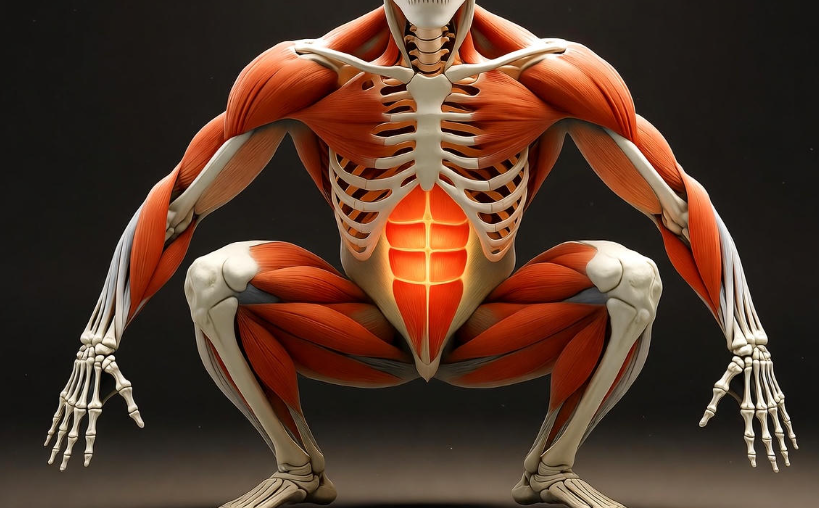

When you think of powerful movements in fitness, few can compete with the squat. It’s simple in concept—just bending down and standing up—but behind that simple move lies an amazing combination of muscle coordination, balance, and biomechanics. Squats are often called the “king of all exercises,” and for good reason: they work multiple joints, engage numerous muscles, and build not only strength but also stability.
But what really happens inside your body when you perform a squat? And how does your core—that complex web of muscles around your midsection—help stabilize and power the movement? Let’s take a closer look at what’s going on under the surface. 🏋️♂️
Understanding the basic movement pattern
A squat is more than just sitting down and standing back up. It’s a compound movement that involves the hips, knees, and ankles working together in perfect coordination. The movement starts at the hips, not the knees. When you descend into a squat, your hips move back, your knees bend, and your ankles flex to keep your balance.
Your body has to maintain its center of gravity over your feet. If you lean too far forward, you’ll stress your lower back. If you lean too far back, you’ll lose balance. That’s where your core activation comes in—it keeps your spine neutral and your movement controlled.
Muscles involved in a squat
Every time you squat, your body uses multiple muscle groups at once. Here’s a breakdown of the major players involved:
| Muscle Group | Role During Squat |
|---|---|
| Quadriceps (front thighs) | Extend the knee during the upward phase |
| Gluteus Maximus | Drives hip extension to stand up |
| Hamstrings | Help control the descent and stabilize hips |
| Adductors (inner thighs) | Keep the knees from caving in |
| Calves | Maintain balance and assist ankle movement |
| Core Muscles | Stabilize the spine and pelvis |
The beauty of squats lies in how all these muscles work together. You’re not isolating one part of your body—you’re teaching your body to move as a single, coordinated system.
The role of the core in squats
The word core doesn’t just mean your abs. It includes the rectus abdominis (the six-pack muscle), obliques, transverse abdominis, erector spinae (along your spine), and even the diaphragm. These muscles create a natural “belt” around your torso, protecting your spine and keeping it aligned.
When you squat, your core muscles contract to create intra-abdominal pressure—a sort of internal brace that stabilizes your torso. Imagine tightening your stomach before someone pokes you—that’s your core working. This pressure helps reduce the load on your spine, keeping it safe even when lifting heavy weights.
If your core is weak, your body can’t transfer force effectively from your legs to the barbell (or to your upper body). That means less power, less balance, and higher risk of injury.
How biomechanics affect squat form
The biomechanics of a squat depend on several factors like body proportions, joint mobility, and even foot position. For example:
-
People with long femurs (thigh bones) tend to lean more forward to keep their balance.
-
Those with shorter torsos may naturally stay more upright.
-
Limited ankle mobility can prevent you from achieving depth and proper balance.
This is why no two squats look exactly the same. The “perfect” form isn’t about looking like someone else—it’s about maintaining a neutral spine, balanced weight distribution, and control throughout the motion.
The kinetic chain: from feet to head
Every part of your body plays a role when squatting. Your feet provide the foundation, gripping the floor and controlling balance. Your ankles allow you to flex and shift your weight. The knees and hips move as joints that generate and absorb force, and the spine remains the stable axis around which the movement occurs.
This chain of motion—called the kinetic chain—depends on smooth communication between muscles and joints. If one link in the chain is weak or misaligned (like unstable knees or tight hips), the whole movement suffers.
Common mistakes in squat biomechanics
Even though squats seem simple, small mistakes can lead to poor performance or injury. Here are a few you might recognize:
-
Knees caving inward (valgus collapse): Often due to weak glutes or adductors.
-
Rounding the lower back (butt wink): Caused by tight hamstrings or poor hip mobility.
-
Heels lifting off the floor: Usually a sign of restricted ankle flexibility.
-
Leaning too far forward: Weak core or excessive load on the bar.
Fixing these issues often comes down to strengthening weak muscles, improving flexibility, and focusing on form before adding weight.
Breathing and core activation during squats
Breathing might seem like a simple task, but during squats, it’s one of the most important biomechanical factors. Proper breathing supports core activation and helps protect your spine.
The technique most lifters use is called the Valsalva maneuver—taking a deep breath, holding it through the descent, and then exhaling as you rise. This helps maintain intra-abdominal pressure and spinal stability.
Tip: Don’t hold your breath for too long; you should exhale once you’re past the hardest part of the lift to avoid dizziness or excessive pressure.
Depth and range of motion
How low should you go? The answer depends on your mobility and goals. A “parallel” squat (where thighs are parallel to the ground) is the minimum standard, but full-depth squats—where your hips drop below your knees—activate more muscle fibers in the glutes and hamstrings.
However, going too deep without proper form or flexibility can put stress on your knees and lower back. So, your goal should be to achieve depth with control, not just to go as low as possible.
Core activation drills for better squats
Before hitting the squat rack, doing a few core-activation exercises can make a big difference. Some great ones include:
| Exercise | Purpose |
|---|---|
| Plank | Builds total core stability |
| Dead Bug | Teaches core control while moving limbs |
| Bird Dog | Strengthens back and core connection |
| Pallof Press | Trains anti-rotation strength |
| Glute Bridge | Activates hips and lower core |
Try doing these before your workout to “wake up” your stabilizing muscles. You’ll notice improved control and balance during squats.
Squat variations and biomechanics changes
Not all squats are created equal. Different variations emphasize different muscles and mechanics:
| Squat Type | Biomechanical Focus | Key Muscle Emphasis |
|---|---|---|
| Back Squat | Posterior chain (hips, glutes, hamstrings) | Glutes, hamstrings |
| Front Squat | Upright posture, more knee flexion | Quads, core |
| Goblet Squat | Balanced beginner movement | Quads, glutes, core |
| Sumo Squat | Wide stance, hip adductor focus | Adductors, glutes |
| Overhead Squat | Full-body balance and mobility | Core, shoulders, quads |
Each variation slightly changes the joint angles and load distribution, giving your body new challenges and keeping your progress well-rounded.
Injury prevention and healthy biomechanics
Squats are safe if done correctly. But poor mechanics—like letting the knees collapse or rounding your back—can lead to overuse injuries. The key is gradual progression, proper mobility work, and consistency.
Always warm up your hips, knees, and ankles before squatting. Use lighter weights to practice your form and ensure your core stays tight throughout. Remember, your spine should move as one solid piece, not bend under load.
Why squats improve overall athleticism
The biomechanics of squats don’t just apply in the gym—they transfer to everyday life. You use the same mechanics when you stand from a chair, climb stairs, or lift something heavy. That’s why squats improve athletic performance, functional strength, and even posture.
When your core and legs work together efficiently, your body becomes stronger, more balanced, and more resistant to injury.
Fun fact 💡
Did you know? The world record for a raw back squat (without support gear) is over 500 kg! That’s possible only because of flawless biomechanics and insane core stability.
FAQs
Q1: Why does my lower back hurt when squatting?
Usually, it’s due to poor form or weak core muscles. Make sure your spine stays neutral, and don’t overload the bar before mastering technique.
Q2: Should I squat below parallel?
If your flexibility allows it and your form remains good, yes! It activates more muscle fibers. But don’t force depth—build mobility first.
Q3: How often should I squat per week?
For most people, 2–3 times a week is ideal. It gives your muscles time to recover while improving strength steadily.
Q4: Do squats make your core stronger?
Absolutely! Squats require intense core activation to stabilize your body. They strengthen your abs and lower back naturally.
Q5: Can beginners do squats safely?
Yes, start with bodyweight squats to learn form. Once you’re comfortable, gradually add weights and keep your posture correct.
Final thoughts
The biomechanics of squats and core activation reveal that this movement is more than just leg training—it’s a full-body coordination exercise. Every joint, muscle, and stabilizer plays a role in keeping you balanced and powerful. When done right, squats improve strength, stability, and even confidence.
So next time you squat, remember: it’s not just about bending your knees. It’s about moving with purpose, control, and awareness of what your body is truly capable of. 💪