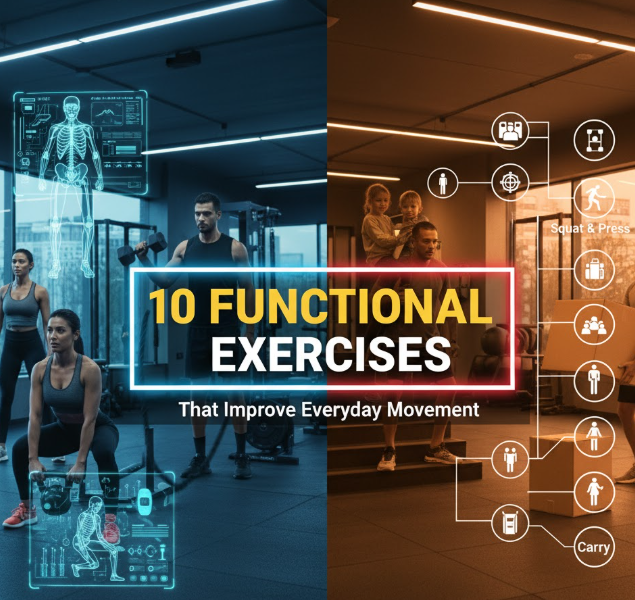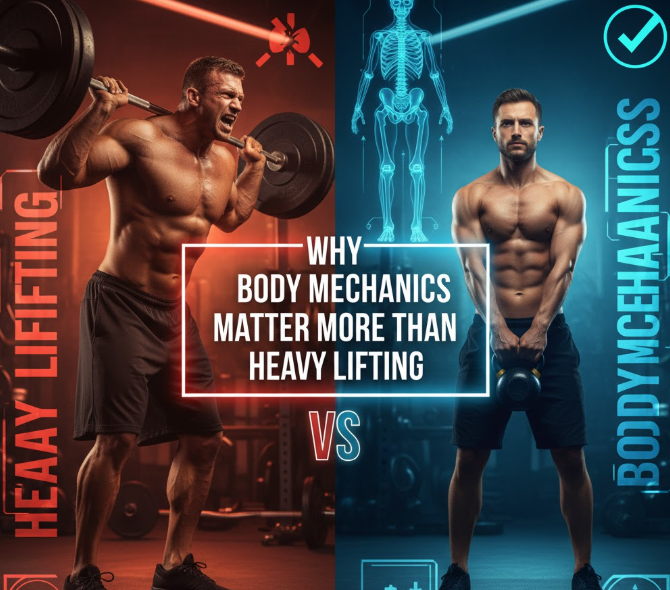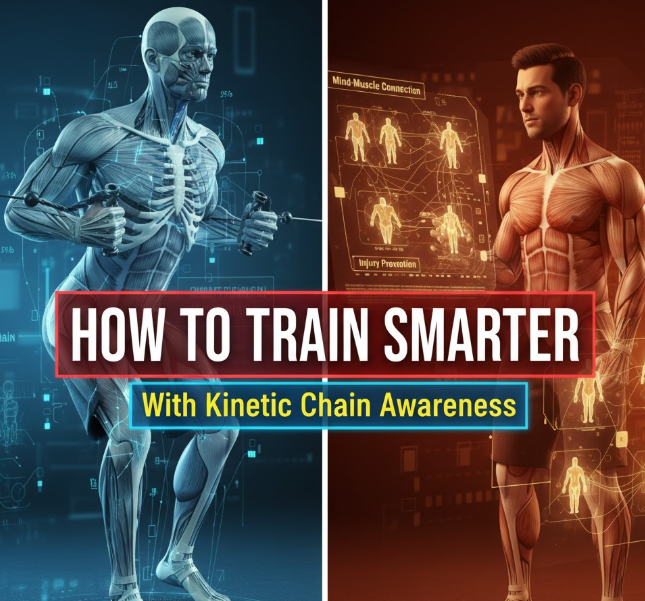
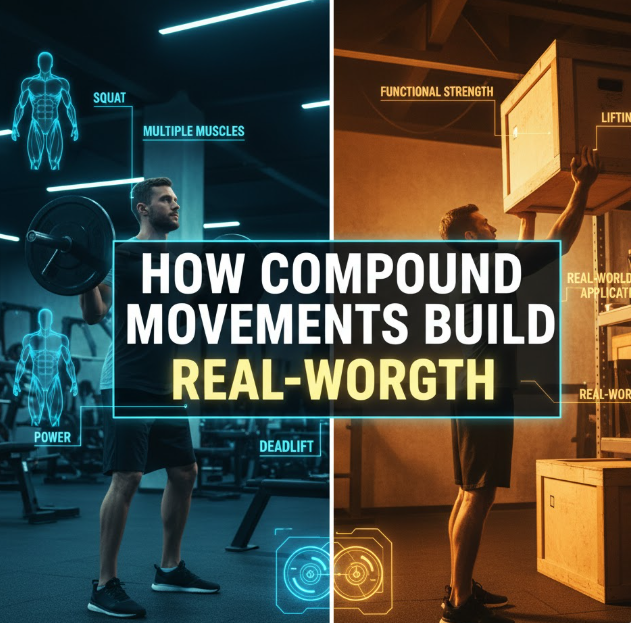

Imagine you are helping a friend move into a new apartment. You squat and lift up a large box, hoisting it and carrying it upstairs to place it down gingerly. Your legs push, your back stabilizes, your arms clamp down and your center locks everything in place. That’s functional strength in action—and that’s exactly what compound movements train your body to do.
Unlike those fancy machines at the gym that target just one teensy muscle in isolation, compound movements work several muscles (and sometimes even more than one muscle group) at once — just like life expects us to. Even if you’re just lifting groceries, playing sports or chasing your dog around the yard: Your body never works one muscle in isolation. Everything works together, and compound exercises train your muscles to communicate and work in harmony like a machine.
In this article, we will dissect why these compound moves are your secret weapon to building practical and functional strength that you can actually use outside the gym. You’ll find out which exercises give you the most bang for your buck, how they stack up against isolation exercises and why everyone from athletes to firefighters to average folks swear by this kind of workout.
What Makes Compound Movements Different
What are compound movements? Compound movements are exercises that require movement around more than one joint, and work multiple muscle groups simultaneously. Consider the squat — your ankles, knees and hips are all bending and straightening together while your quads, hamstrings, glutes and core muscles all come together to do the job. Compare that to a leg extension machine, which only bends your knee and works all of nothing but your quads. See the difference?
When you do compound exercises your body learns to generate force, transfer it across multiple joints and stabilize all at once. And that coordination reflects how you move in the real world. No one targets their bicep when they grab a toddler from underfoot, or their hamstring when running for the bus.
And the magic comes from the fact that compound exercises force your nervous system to get smarter. Your brain must process signals to and from multiple different muscle groups, telling them when to contract, how hard you should push and how to work together efficiently. Over time, that neural adaptation makes you not just stronger, but better at handling real-world, unpredictable challenges.
The Big 5: Exercises That Change Everything
There are dozens of compound exercises to choose from, but here’s our top 5 that will build you the functional strength needed for combat sports. These are the exercises that have withstood the test of time, across various different training philosophies and sports.
Squats – King of Lower Body Power
Squats engage your quadriceps, hamstrings, glutes, calves and core muscles simultaneously. They teach your body to produce power from the ground up — crucial for jumping, running and lifting heavy loads. Whether you’re performing back squats, front squats or goblet squats, you’re practicing the very movement pattern your body uses every time you sit down and stand up.
The great thing about squats is that there are so many variations. You can do them using a barbell, dumbbells or kettlebells as well as just your body weight. Each variation asks your body the same thing, just slightly different: push through with your legs and protect with a stable torso.
Deadlifts: The Ultimate Full-Body Builder
If there’s one lift that just screams “functional strength,” it’s the deadlift. This will engage your hamstrings, glutes, lower back, upper back, forearms and core. It’s quite literally the act of picking up something heavy off the ground — the most useful movement pattern that exists.
Deadlifts teach you how to hinge at the hips which help keep your low back safe in everyday activities. Once you become a deadlift master, you’ll start using better form for everything heavy you pick up, from the laundry basket to furniture. Your body automatically knows to drive through your legs and maintain a neutral spine, rather than rounding your back and putting yourself at risk of getting hurt.
Bench Press: Upper Body Pressing Strength
The bench press works your chest, shoulders and triceps with stability from the core. This pushing aspect is the action of pushing open heavy doors, pushing yourself off the floor or pressing objects overhead. Even though it might seem on the surface like it’s simply an upper-body exercise, your legs, core and back all engage to create a solid platform for pressing.
There are many, many variations — flat bench, incline, dumbbell press (all done at varying inclines) — but all train your body to create a pushing force while maintaining the stability and protection of your shoulder blades. This interplay between strength and stability is why the bench press is so deeply relevant to shoulder health and upper body power.
Rows: Building a Strong Back
Rows — barbell rows, dumbbell rows, cable rows; they’re all a little different but the end goal is to get your body used to pulling weight toward you. This move targets your lats, rhomboids, traps and rear deltoids — not to mention your biceps — while requiring a whole lot of core stability in order to keep yourself from completely flopping over.
In real life, rowing strength enables you to pull open doors, get a lawnmower up and running, do yard work and sit with good posture. A strong back from rowing workouts serves as a counterbalance for all the forward movements modern life encourages, from driving to typing to staring at phones.
Pull-Ups: The Bodyweight Challenge
Pull-ups are perhaps the most humbling exercise in your gym but also reward you greatly. They engage your lats, biceps, forearms and core and instruct your body to move its own weight through space. This ability correlates to climbing, hanging and pulling yourself up in an emergency.
If you still can’t do a full pull-up, this goal is excellent for building monster upper body and core strength. Assisted pull-ups, negative pull-ups and band assisted pulling all mimic the movement pattern and muscle coordination.

Why Your Muscles Get Along So Well
So when you do isolation exercises, you are making individual muscles work and asking the others to stay relatively calm. But compound movements create something that’s called “irradiation”—when one muscle contracts intensely, it signals the surrounding muscles to contract as well. This spillover effect is like building strength for all of your system.
Consider the heavy deadlift. Your grip on the bar is hard and fast, and your forearms lit up with activity. That tension radiates through to your biceps and shoulders. Your core tenses up to support your spine, and that means tension in the rest of your torso. Your glutes and hamstrings connect to your hips with fierce power. Everything is linked and everything reinforces everything else.
This full-body tension trains your muscles to support one another. Your body intuitively enlists this full-body coordination when required to lift something heavy in real life, instead of attempting to utilize isolated muscles. You grow stronger not just as individuals but as a system.
You get a much different, hormonal response in terms of the body’s response when you are doing compound movements versus isolation work. Big compound exercises stimulate more testosterone and growth hormone, which are essential for muscle building and strength. Your body understands these actions as valuable survival skills and acts to make you more capable.
How Compound Movements Stack Up Against Machines
| Feature | Compound Movements | Machine/Isolation Exercises |
|---|---|---|
| Muscles Worked | Multiple muscle groups | Single muscle or small group |
| Joints Used | Two or more | Typically one |
| Core Activation | High—needed for stability | Low—machine provides stability |
| Balance Required | Yes—you stabilize the weight | No—machine is responsible |
| Real-World Application | Direct carry-over to everyday life | Limited functional carry-over |
| Time Efficiency | Work multiple muscles simultaneously | Must do multiple exercises |
| Calorie Burn | Higher since more muscles in use | Lower per exercise |
| Coordination Development | Rapid improvement | Little improvement |
| Learning Curve | Steeper — technique practice needed | Easier — machine sets path of movement |
| Injury Risk When Done Wrong | Greater risk with improper form | Less as machine is controlled |
That’s not to say isolation exercises are worthless. They certainly have their place for rehab, correcting muscle imbalances and increasing volume in the muscles, but they are not exactly going to pack on mass. But when it comes to developing practical, real world strength quickly, compound movements offer you much more bang-for-your-buck when training.
The Science Behind Functional Strength
The way force travels through your body is what scientists who study human movement refer to as the “kinetic chain.” When you jump, force is produced from your feet into the ground, which travels up through the ankles and knees, then transfers through the hips and core before expressing up to the upper body. Every link in this chain is important.
Compounds are about developing the kinetic chain as a whole. When you do a squat, you’re not just strengthening your legs—you’re simultaneously training your nervous system to control force production across multiple joints. This neurological adaptation may be at least as important as the muscle growth.
Research has indicated that individuals who trained predominantly with compound movements have better “rate of force development”—or are capable of producing power more quickly. This attribute is enormously important in practical applications. Whether you’re preventing a fall, sprinting after a bus or reacting in sports, the ability to generate force immediately is what determines whether you succeed.
Your sense of proprioception—your body’s understanding of where it is in space—better improves with compound movements, too. Unlike machines, which impose a fixed movement on your body, free-weight compound exercises demand ongoing micro-adjustments to balance and control the weight. These adjustments teach the small stabilizer muscles and build your body-spatial awareness so that you are more coordinated and at less risk for injury.
Building Strength That Actually Matters
Real-world strength isn’t about how much you crank out on a machine in an ideal environment. It’s about what you can do when the weight suddenly shifts, when you are on uneven ground, when you’re tired or when you have to move awkwardly.
Think about the contrast between a powerlifter and a bodybuilder. The bodybuilder may have larger muscles as a result of lots of isolation work over the years, however the powerlifter that trains mostly with compound movements usually has greater functional strength. They can help you lift furniture more easily, perform manual labor more efficiently and adapt to unexpected physical challenges with less difficulty.
This flexibility comes from training movements, not muscles. Train your body to execute the squat pattern hundreds of times, and it starts getting very efficient at just that. So when you do need to raise a heavy box from the bottom shelf, your body naturally goes into that well-practiced pattern. Not something you have to ponder upon—the movement is already programmed within your nervous system.
Compound exercises also help to develop “strength endurance”—the ability to perform forceful movements repeatedly without tiring. In order to recruit so many muscles at once, leaving them no option but to provide oxygen and nutrients in an amount sufficient for every muscle to do its job, your heart and lungs need to distribute that oxygen and those nutrients just as effectively. This dynamic results in the endurance that enables you to work in the yard all day or play with your kids without feeling wiped out.
Your Way to The Mastery of Compound Movement
If you’re new to compound movements, remember that good technique is more important than weight. There’s so much about heavy loads, which is what a lot of people jump into, and they end up getting injured or creating bad movement patterns that hold them back.
Start relatively light, either with bodyweight variety or super light weights. Practice squats without any weight until your body has the motion down. Get the hip hinge pattern down on a PVC pipe before you even think about touching a barbell. Become a master at pushups before ever loading the bench press. This foundation phase may seem dull, but it yields massive returns later.
Maybe you could see a good coach/trainer for a couple of sessions to get started. They can observe your movement, notice the problems you cannot see or feel yourself and give you particular cues to help. Videoing yourself from various angles, even more than once per session, also allows you to watch for issues with your form.
Progress gradually. You can incrementally increase ~5-10 lbs/week on your compound lifts so that your muscles, tendons and nervous system can adapt to gradually hold those weights safely. Leaping too soon has a chance of working for some time, but also increases risk of injury significantly and may mean weeks, months or more of lost training.
Common Mistakes That Will Slow Your Progress
So many people shoot themselves in the foot when it comes to their compound movement training. One common mistake is to rush through reps. Compound movements demand control and intent. Bouncing out of the bottom of a squat or yanking a deadlift off the floor might get more weight moved in the short term, but it eliminates the strength building stimulus and increases your risk of injury.
Ignoring mobility work is another mistake. Good range of motion at the joints are necessary in compound movements. When you’ve got stiff ankles, your squat deteriorates. If your shoulders don’t have mobility, this puts you at risk for injury on the overhead press. Spend 10-15 minutes doing some mobility work before you train, and this will be money invested greatly in movement quality.
Folks also have a tendency to program compound movements poorly. It may sound tough to deadlift heavy, squat and row all in the same session, but it’s often not productive. These exercises stress your nervous system a lot. Intelligent programming distributes these throughout the week with enough recovery in between to be decent.
Neglecting core strength is another common trap. Compound movements are the exchange market—your core is where force is traded. A weak core lets force leak out during training, so you can’t lift as much and are more likely to get injured. Specialized core work improves all of your compound lifts.
How Athletes Harness the Power of Compound Movements
Practically all types of athletes focus heavily on compound exercises in their programs. Basketball players squat and deadlift because they use explosiveness to jump. Football players use cleans and presses to develop the strength for tackles and blocks. Runners use single-leg compound exercises to enhance their running economy and mitigate injury.
It’s simple: Sports don’t take place in a vacuum. A basketball player doesn’t simply jump with just his calves—he is jumping using all of his muscles in a carefully orchestrated sequence of muscle contraction. Training in the gym with compound movements develops this integrated strength that rolls over onto the court.
Combat athletes have the most to gain from compound lifting and that’s because fighting is all about full-body power production under fatigue and under weird positions. A fighter who can generate force through his legs, transmit it through his core and express it through the arms in the blink of an eye has a colossal edge. Compound movements produce this very type of integrated strength.
Endurance athletes, which in theory only need to train the cardio system, still derive huge benefit from compound strength work. It’s also more powerful in each stride when your legs are stronger. A stronger core also provides better running or cycling posture when you are tired. Stronger shoulders and backs make swimming more efficient. The applications are endless.
Your Weekly Training Blueprint
It is not necessary to have a complex compound movement program. Here is an easy framework that will address all the big-muscle movement patterns two times per week:
Monday: Lower Body Push Focus
- Squats (3 sets of 5-8 reps)
- Romanian Deadlifts (3 sets of 8-10 reps)
- Lunges (2 sets of 10 each leg)
- Core work (3 sets of 20-30 seconds)
Wednesday: Push and Pull with the Upper Body
- Bench Press (3 sets of 5-8 reps)
- Barbell Rows (3 sets of 8-10 reps)
- Overhead Press (3 sets of 6-10 reps)
- Pull-ups or Lat Pulldowns (3 sets to failure)
Friday: Lower Body Pull Focus
- Deadlifts (3 sets of 3-5 reps)
- Front Squats or Goblet Squats (3 sets of 8-12 reps)
- Step-ups (2 sets of 10 on each leg)
- Core work (3 sets of 20-30 seconds)
This template includes heavy, powerful multi-joint movements and enough rest between like-exercises. You can dial the exercises, sets, and reps up or down depending on your goals and experience level, but the structure gives you a good starting point.
For more detailed guidance on proper lifting technique and programming, check out StrongLifts 5×5, a popular beginner strength training program based on compound exercises.
Measuring Your Real-World Strength Gains
The gym numbers matter—knowing your squat, deadlift and pressing weights lets you see easy progress. But the true measure of functional strength will come in finding that daily life becomes easier. Notice the following signs that your compound movement training is paying off:
You fetch the groceries from the car in fewer trips. That heavy load of bags that once took double the trips now gets done in a single go. Your deadlift ability basically equates to how much you can lift and carry.
Yard work becomes easier. It feels less tiring to push the lawnmower, lift bags of mulch or dig in the garden. Physical work is less daunting because of less CNS fatigue combined with full-body strength and endurance from compound movements.
Running around with children or dogs? You don’t wear down as fast. Repeatedly bend over or pick them up, scoop them and chase them around, stand up/sit down on the floor—these things just happen without killing you.
You get better posture without ever thinking about it. The back strength from rows and deadlifts, and the core strength from all compound movements further serve to naturally pull your shoulders back and keep your spine in line. People might even wonder if you have grown taller.
You are more sure of yourself in physical stuff. Whether it’s moving a neighbor’s furniture or rising to an impromptu physical challenge, you trust your body will accommodate what life throws at you. The confidence from this, too, is worth it in and of itself!
Frequently Asked Questions
How many times a week should I do compound exercises?
For most, training compound movements 3 to 4 times per week with a day of rest between the same muscle group exercises tends to work best. This frequency permits sufficient stimulus for adaptation and permits enough time to recover. Beginners may do 2-3 sessions a week, with experienced lifters managing higher frequencies if they control volume and intensity.
Can I gain muscle with compound exercise, or do I also have to use isolation exercises as well?
You certainly can grow big muscles with only compound lifts. They offer a lot of stimulus to help you build muscle. That said, some isolation work can be useful in addressing certain weaknesses or imbalances. Almost everyone gets 80-90% of results from compound movements and does isolation exercises as just accessory work.
Is it safe for a beginner to do compound movements?
Yes, if learned appropriately with appropriate weights. The trick is to begin with nothing at all or very light weights and make sure your form is perfect before increasing the weight. Many people benefit from the initial help of a coach, learning proper form and what-not-to-do before trying solo.
How long does it take to see actual strength gains?
Most people will notice functional strength gains in 4-6 weeks when they start incorporating compound movement-intensive workouts. Your nervous system adapts rapidly and you become more coordinated and better able to produce force. Real muscle growth takes more time—think 8 weeks, if not more, of dedicated resistance training—but the good news is that you’ll feel those benefits almost instantly.
What is the difference between strength and muscle size?
Strength is your capacity for force, which will be influenced by both muscle size and neurological efficiency. You can become much stronger without adding much muscle by learning to recruit your muscle fibers efficiently. Training volume, over time, is a major component of muscle growth. The compound lifts do the best job of developing both strength and size.
Do I need a gym membership to do compound exercises?
Not necessarily. Barbells and weight availability certainly make progress easier, but you can do plenty of effective compound movements at home with minimal equipment. Bodyweight squats, push-up variations, inverted rows on a table, and single leg exercises give you plenty of training options. A couple of dumbbells or kettlebells increases your freedom of movement enormously.
Is it safe for the elderly to do compound exercises?
Absolutely. Actually, compound exercises might be even more significant for older people, because they sustain functional independence. The trick is choosing the right weight, good form and a modified version of the exercise. Studies consistently demonstrate that resistance training, especially exercises targeting multiple muscle groups or compound movements, for older adults helps increase and maintain muscle mass and bone density, as well as improve balance and functional capacity.

The Bottom Line: Strength For Life, Strength To Serve Your Life
Compound exercises are hands down the best and most efficient way to develop real-world strength outside of the gym. They teach your body to move the way it was designed to move—using multiple muscles in combination patterns that mimic real-life activities.
You can do isolation exercises if that is what you like, but nothing will make you strong in a practical and functional sense like squats, deadlifts, presses, rows and pull-ups. These movements bring you more than just bigger muscles, but rather a nervous system with an enhanced capacity, better coordination, improved balance and the kind of confidence that comes from knowing your body can handle physical challenges.
Compound movement training is a thing of beauty for its simplicity. And you don’t need complex, sophisticated programs and fancy equipment or to spend multiple hours a day in the gym. Pick a few fundamental movement patterns to focus on, add weight as you go, and be consistent with your training. The power you develop will benefit you in more ways than one—from being able to move thoughtfully and with ease through life’s daily movements, to remaining independent as you get older, to excelling in sports and activities.
Real-world strength is not about impressing people at the gym. It’s being able to live a more capable, confident life where physical challenges don’t keep dragging you down. Compound exercises develop exactly that type of strength—functional, practical and usable in your actual life. Begin to add it into your training and you will find that getting stronger means everything becomes easier, more fun, and a greater possibility.