

If you’ve ever watched an athlete sprint across a field, leap into the air, or lift heavy weights effortlessly — you might’ve wondered: What kind of strength is that? 💪
Well, that’s not just gym strength — it’s called functional strength. It’s the kind of power your body develops to move naturally and efficiently in the real world, not just on machines or in front of mirrors.
Sports scientists have been studying this concept for decades, and what they’ve found might surprise you — it’s not just about lifting heavier, it’s about moving better. Let’s dive deep into what the science really says.
What Functional Strength Actually Means (Not What You Think)
Functional strength isn’t about how much weight you can bench press. It’s about how your body performs when faced with real-life tasks — from carrying groceries 🛍️ to sprinting, twisting, or catching yourself from falling.
Sports researchers define it as the ability of your muscles, joints, and nervous system to work together efficiently in dynamic situations.
Think of your body as a team — if one muscle is overworked and others are lazy, your performance collapses. Functional training fixes that by improving coordination, stability, and movement quality rather than just muscle size.
How Sports Scientists Measure Real Functional Power
Here’s something interesting — sports scientists don’t just measure strength by how much weight an athlete lifts. Instead, they look at things like:
| Measurement | What It Tells About Functional Strength |
|---|---|
| Ground Reaction Force | How efficiently your body produces power against the floor |
| Muscle Activation Patterns (EMG) | How different muscles coordinate during motion |
| Rate of Force Development (RFD) | How quickly you can generate force – crucial for athletes |
| Movement Efficiency Tests | How smooth and stable your motion patterns are |
| Core Stability Scores | How well your trunk supports complex movements |
According to the Journal of Strength and Conditioning Research, athletes with high RFD (Rate of Force Development) are not only stronger but also faster and more agile — because their muscles “fire” in better coordination.
Why Functional Strength Is Different From Traditional Gym Training
Here’s the secret — machines make you stronger in isolation, but weaker in function.
When you’re sitting on a leg press machine, your stabilizer muscles (the small ones that keep you balanced and aligned) are taking a nap. 😴
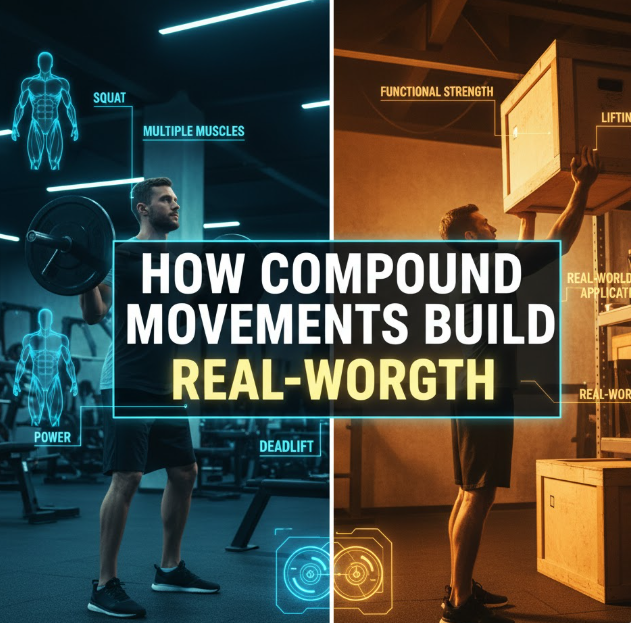
But when you squat with a barbell, your body recruits multiple muscle chains — legs, hips, core, and even upper back — all firing together.
That’s why functional exercises like:
-
Squats
-
Deadlifts
-
Lunges
-
Kettlebell swings
-
Medicine ball throws
…are considered far superior for real-world performance.
Sports scientists from the University of Wisconsin found that multi-joint exercises activate 40% more muscle fibers than single-joint machine work.
The Brain-Muscle Connection (Your Hidden Power Source)
This is where things get fascinating 🤯 — functional strength is not just about the muscles; it’s also about how your brain talks to them.
When you do balance-driven, coordination-based movements, your nervous system becomes sharper. It learns to “map” body positions faster.
That’s why athletes often train barefoot or on unstable surfaces — it wakes up the sensory feedback loops in the body.
According to sports neuroscience research, exercises that challenge balance improve neuromuscular efficiency, meaning your muscles respond faster and with more accuracy.
So the next time you do a lunge on a wobble board or a one-leg squat, remember — you’re actually training your brain as much as your body. 🧠
Functional Core Strength: More Than Just Abs
When sports scientists talk about “core strength,” they don’t mean just your six-pack. They mean your entire trunk system — abs, obliques, diaphragm, and spinal stabilizers.
Why does it matter? Because every movement starts from the core. Whether you’re throwing a punch, running, or jumping — power transfers from your center outwards.
In a study published by the National Strength and Conditioning Association, athletes with strong deep-core muscles had:
-
Better balance
-
Faster sprint times
-
Fewer lower-back injuries
So, crunches alone won’t cut it. You need planks, rotational twists, and functional moves that teach your core to stabilize, not just flex.
Functional Strength = Stability + Mobility + Power
Here’s a simple equation used by sports coaches:
👉 Functional Strength = Mobility × Stability × Power
If even one of these is missing, performance drops. For example:
-
Too mobile but not stable → higher injury risk.
-
Strong but stiff → limited range and slow movement.
So, the smartest athletes train in all three zones. They stretch dynamically, stabilize joints, and then build explosive power on top.
The Science of Compound Movements
Functional training relies on compound movements — actions that use several joints and muscles together.
Here’s how they compare to isolation exercises:
| Type | Example | Benefit |
|---|---|---|
| Compound | Deadlift, Push-up, Lunge | Builds real-world coordination and total strength |
| Isolation | Bicep Curl, Leg Extension | Improves one muscle but limits real application |
Research shows that compound training enhances hormonal response, including testosterone and growth hormone, leading to more natural muscle development.
So yes, that’s why functional athletes often look athletic without being bulky — their bodies are efficient, not just inflated. 💥
Real-Life Application: Why Functional Strength Matters
It’s not only for athletes. Everyone benefits from it.
-
Office workers reduce back pain
-
Elderly people improve balance and avoid falls
-
Manual laborers move more efficiently
-
Even gamers can reduce shoulder and neck tension
Functional fitness improves posture, breathing, energy, and movement confidence — things we all need daily.
Sports Scientists Reveal the “Secret Formula” for Functional Gains
According to elite sports labs, the following five elements make the perfect functional training routine:
-
Movement Patterns – Push, pull, hinge, squat, rotate, carry
-
Core Integration – Always involve the trunk
-
Unstable Surfaces – Use balance boards, TRX, or single-leg positions
-
Explosive Power – Include short bursts like jumps or medicine ball slams
-
Recovery & Mobility Work – Foam roll, stretch, and rest strategically
When these five combine, your nervous system upgrades itself — like a performance software update for your body. ⚡

Functional Strength Myths (Busted by Science)
❌ Myth 1: Functional strength is only for athletes.
✅ Truth: Everyone needs it to move safely and efficiently.
❌ Myth 2: It’s less intense than weight training.
✅ Truth: Functional training can be even more demanding because it engages more muscle groups at once.
❌ Myth 3: You need fancy equipment.
✅ Truth: Your body weight is often enough — just add creativity and balance.
How to Train for Functional Strength (Science-Approved Plan)
Here’s a simple 4-step weekly plan you can try:
| Day | Focus | Example Exercises |
|---|---|---|
| Day 1 | Lower Body + Core | Squats, Lunges, Plank Holds |
| Day 2 | Upper Body + Stability | Push-ups, Rows, Shoulder Taps |
| Day 3 | Mobility + Balance | Yoga Flows, Single-Leg Stands |
| Day 4 | Power & Conditioning | Kettlebell Swings, Sprints, Jumps |
Make sure you warm up dynamically and finish with stretches or foam rolling.
And remember: good form beats heavy weight every time.
Nutrition and Recovery Secrets That Support Functional Strength
Even the strongest movement patterns collapse without recovery. Sports scientists emphasize three recovery pillars:
-
Protein Intake: Repair muscle fibers. (1.6–2.0g/kg of body weight)
-
Sleep Quality: Deep sleep triggers muscle repair hormones. 😴
-
Active Recovery: Gentle walking, stretching, or yoga enhances blood flow.
Add hydration, omega-3s, and antioxidants — your muscles and joints will thank you.
Final Thoughts — Function Over Fashion 💡
Functional strength is the foundation of athleticism, agility, and real-world capability.
It’s not about looking strong; it’s about being strong — in motion, in balance, and in control.
So, the next time you train, think beyond muscles. Think about how your body moves as one intelligent, integrated system. Because that’s what sports scientists call true strength.
FAQs
Q1: Can I build muscle with functional training?
Yes! Functional training builds lean, athletic muscle by engaging multiple muscle groups at once. It might not make you bulky, but it’ll make you powerful.
Q2: Do I need equipment for functional strength?
Not always. Your body weight is enough. But tools like kettlebells, medicine balls, and resistance bands can add challenge and variety.
Q3: How long before I see results?
Usually within 4–6 weeks, you’ll notice better balance, posture, and stamina — visible strength follows soon after.
Q4: Is functional strength better than bodybuilding?
They serve different goals. Bodybuilding builds muscle size, while functional training builds usable strength and movement quality.
Q5: Can older adults do functional training?
Absolutely. In fact, it’s one of the safest and most effective ways for seniors to maintain independence and joint health.